Poster Presentation
December 11, 2009More on War Propaganda Posters
November 24, 2009Many were illustrated with compelling images of heroes, sacrifice and family values. While some encouraged the purchase of war bonds and solicited donations for non-profit organizations such as the Red Cross, others promoted patriotism and warned against aiding the enemy with careless talk. The study of this medium leads us to a greater understanding of their effectiveness as tools for propaganda, aids in the analysis of national cultural and symbolic values, and helps define ideological differences between nations at war.
W University Libraries University of Washington Digital Collections War Poster Collection
Fillmore Posters
November 20, 2009Bill Graham & the Fillmore Poster Origin- San Francisco Mime Troupe Nov. 5, 1965- Bill Graham’s first small poster- simple with hand-printed calligraphy, stated info
“after the fifties and early sixties with their years of repressive morality, etiquette and grooming codes, creative people were essentially in need of a big “hairy” change.” pg. 11
scene evolves from Beat and Folkies to beginnings of Haight-Ashbury Acid Rock culture
young culture breaks loose in January ’66 in San Francisco Psychedelic Renaissance- questioning of all known concepts
“That was the trip. And that is why posters became beautiful and blossomed and flourished: because they had to say everything. They couldn’t just tell you the information about the show. They had to tell you what kind of people you might meet, what kind of far out trip you might have or perhaps even reveal the mysteries of the universe. Wow. Quantum mechanics, visual mudwrestling, Acid Test pop quiz on a phone pole!”
“You could give your own pad some ‘atmosphere’, some appeal. The beautiful hallucinatory images and illusive feelings that artist tried to capture on paper were alluring. Hundreds of thousands of copies of these posters began selling and dissemination to empathetic souls throughout the realm.”
First Venues were Red Dog Saloon + The Fillmore Mime Troupe Benefits (Bill Graham), The Merry Pranksters (groups on LSD trying to spread psychedelic lifestyle)
Psychedelic art forms: costume, free-form dancing, the light show, the poster
theory behind psychedelic phenomena: mind normally serves as a reducing valve- regulate our experience: order it into categories, set the pace of input, and filter out sensory impressions psychedelic drugs undo all that; flooding mind w impressions
Hollywood Cliche’s
November 6, 2009More articles by Otto Buj. American; French; Polish
“Overcooked cliches for movie posters have been served up by Hollywood admen since the silent era. Pressured to appeal to as many potential ticket buyers as possible, studio posters played it safe by blowing up the head of a bankable celebrity or spotlighting a signature moment of romance or action. For that reason, the history of American poster design is dominated by endless tiresome formulas.” From Otto Buj’s article Buy American, linked above.
French film poster design suffered a similar fate. Cinema was considered entertainment for the lower class in France and so the high poster art tradition of Lautrec and Cheret was reserved only for operas, cabarets and music halls. By the French point of view, only a safe and literal approach to film marketing would be understood by the lower classes.
Polish designers, on the other hand, rejected state imposed social-realism and drew upon the dark and obsessive tradition of Polish Romanticism. Poland enjoyed a “golden age of movie-poster design” from the 50’s to the mid 70’s.
For your consideration I present this 1963 Polish film poster for Hitchcock’s The Birds, designed by Bronislaw Zelek. Notice the complete absence of celebrity cameos.

60’s Poster Art
November 6, 2009The 1960s revolutionized the design, purpose, and collecting of posters, turning low-cost advertising products into decorative statements of one’s personal affiliations and launching a second poster craze. As images of film celebrities, rock bands, and political activists wallpapered dorm rooms within the rapidly expanding collegiate demographic, poster vendors flourished, and the press took notice. Hilton Kramer called it “Postermania” in the New York Times.
While celebrity and activist images were often photographic, much of the poster art of the 1960s sported a radical new look. On the East Coast, the disparate artists of New York’s Push Pin Studios promoted innovation, ignoring Bauhaus-inspired spareness and turning toward more decorative precursors. Milton Glaser’s Dylan quickly became an icon of the era. Psychedelic West Coast rock posters, characterized by swirling colors and illegible lettering, successfully evoked the burgeoning counterculture and were collected throughout the nation and overseas.
National Portrait Gallery
Research Paper Outline
November 6, 2009Thesis: Posters are indicative of the context in which they are made, accessible to and embraced by the public, and typically share a theme of promoting the leisure activities or political agendas.
- Historical artifacts> contextualize culture by depicting fashions, trends, environments, etc., what was deemed entertaining, what was considered eye-catching at the time; popular aesthetic (cabaret, psychedelia, graphic)
- Accessibility> exist on walls of buildings, inside bedrooms, storefronts, essentially anywhere- people could collect with little to no $- not like gallery setting; meant for mass audience instead of inner art circle
- Leisure themes> effectively delivered information along with aesthetic of subject (book, movie, play, music); appeals to artistic eye; go hand in hand bc they are both fun, visual, strengthen impact of one another; Food & wine- luxury; Travel; War themes
The Beginning- Chronology of Print Technology
- Early methods & significance
- Breakthrough in lithography> what this means: reproducing image in color, gestural freedom- new aesthetic
- Screen-printing and contemporary uses
French Poster Art- major players; social context- cabarets, actors, location, people (prostitutes, bourgeoisie, artists> subversive underground mix), art movement
- Industrial Revolution- socioeconomic shift- dispensable income, more leisure time, rise of the middle-class
- Cabarets, first commissions
- Cheret> first Moulin Rouge poster
- Toulouse-Lautrec> handicapped aristocrat w artistic talent> had $ to enjoy cafe/cabaret life, fit in well with seedy, but decadent underground culture> worked to capture brothel scenes, social interactions, and contributed to success of cabarets
- The Academie Standard & Cafe Life Reaction> power taken from exclusive inner circle to artists who gained fame from the masses by capturing the underworld & popular culture of time> issues of reproducing image, color/brushwork techniques; Academie no longer “the IT crowd”
- The actors & their image (propelled by the artists)- Jane Avril, Bruant
- Presence of posters in everyday life> streets of Paris became an art gallery, loved by masses> patronized shows> fueled movement more
American Poster Art, Late 19th Cent.
- Advertising books & magazines (new, emerged at same time as posters)> The artists, main commissioners/publications, popular works
- Immediate craze- collections, limited edition books, poster clubs
- An abrupt end- outselling books they were supposed to be promoting
Other Vintage Posters- Travel, Food & Wine
Old Hollywood Posters
Polish posters
War Posters- America vs. Europe
Psychedelia & Art of the Fillmore
Class blog
October 30, 2009Milton Glaser on Posters video
October 30, 2009Where it all began.
October 30, 2009A documentary about the Gutenberg press that I really enjoyed. This film provides great insight into the history of print and the painstaking process of printing. Without Gutenberg’s invention, poster art and the history of illustration would not exist. Watch the other five parts on Youtube.
Some contextual chronology:
Woodblock prints date back as early as 200CE
Intaglio first attempted in 1430 but not perfected until Rembrandt’s time in the 17th century.
Gutenberg Press begins production in 1450’s and is modified and improved rapidly. More complex and efficient presses are produced constantly.
Lithography invented in 1796.
Photography 1839, photomontage became a popular tool of artists and poster designers in the early 1900’s.
Offset presses in 1903.
Screenprinting, though dating back to the 10th century in the East, and used industrially and by artists in the 19th century, it did not become the cornerstone of the DIY poster artist until Warhol popularized it in the 1960’s.
Film Posters in Poland and the West
October 30, 2009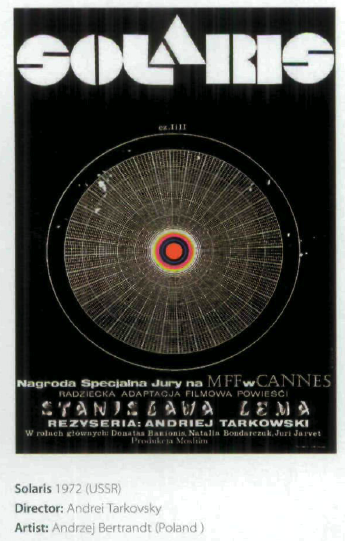
The film poster has a unique place in the poster genre because unlike posters for shows or books or destinations which generally had one poster plastered in the near geography of an event, films traveled and got new posters for each region and language they were shown in. Also, film posters were not collected like other posters because they were controlled by the distributors and loaned exclusively to theatres. After a showing, the posters were either destroyed or returned to the distributor for recirculation. Today, however, film posters are highly sought after by collectors and luckily for them, many distributors held on to the posters rather than destroy them.
After WWII, Polish designers were some of the most prolific and innovative in the genre. Their western European and American counterparts had rigid views of film poster design–views which usually involed bombastic taglines and over-the-top dramatic poses of celebrities themselves. In Poland, however, there were no Hollywood pundits directing the poster design. Rather, Polish artists rejected state-imposed social realism and enjoyed free artistic license under the communist regime so long as their work was not politically objectionable.. They drew influence from soviet constructivism and photomontage. The artists employed the skills they perfected as realists to create stunning designs that were far more conceptual than the celebrity-portraits of American posters. Polish posters often seem cryptic to any viewer not familiar with the film itself.
Follow the link for a pdf of source article. Plastered by Otto Buj


